


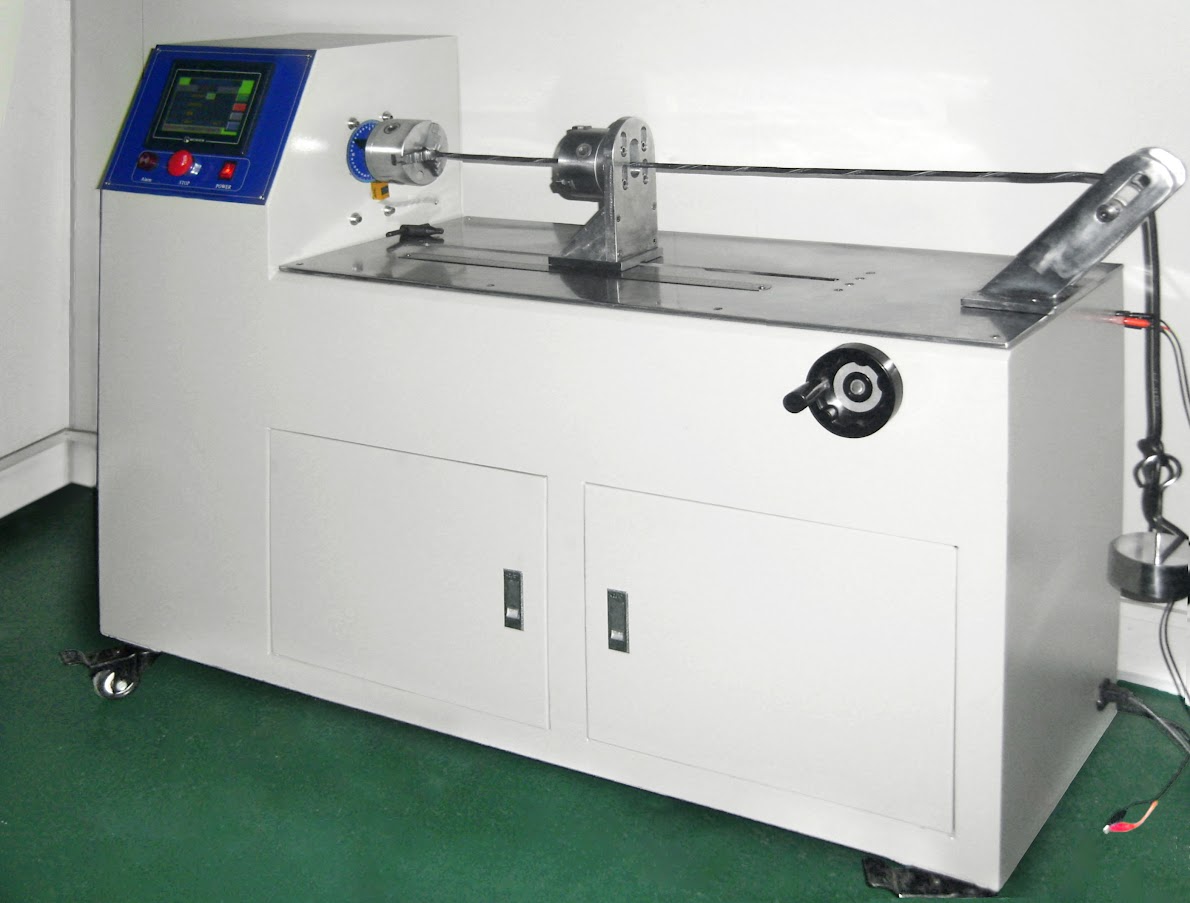
Torsion test machine is suitable for metal and non-metal materials, composite materials and quality inspection departments to torsion small household appliances, such as: hair dryers, hair clips, power cords, earphone cables, data cables, various mobile phone connectors and other electrical connections torsion test. The machine can be converted into various test modes, such as torsion test and swing test. It is a necessary equipment for aerospace, transportation, building materials industry, scientific research departments, various engineering colleges and industrial and mining enterprises to measure torsional performance for mechanical laboratories. The metal test specimens as below mentioned:
| Aluminum Metal Wire: Aluminum Wire, Aluminum Rod, Aluminum Alloy | Copper Metal Wire Cables: Copper Wire, Copper Rod, Copper Alloy |
| Steel Metal Wire: Steel Wire, Steel Rod, Steel Bar | The Other Metal Wires: Bar, FRP, Microfiber, Alloy Steel |

Engineered for accuracy and reliability, the torsion test machine by Wewon Environmental Chambers Co., Ltd. is the premier solution for evaluating the torsional endurance of cables, metal wires, and appliance connections. Fully compliant with rigorous international standards – including ISO 7800, ISO 9649, ISO 2627, ISO/R 957, and JIS C 3005 – This equipment is an essential asset for manufacturing quality control. It is specifically designed to assess the torsional fracture strength of metal wires, the coating resilience of enameled wires, and the connection integrity of power cords, headphone cables, and mobile connectors.
Built to accommodate a wide range of testing needs, the standard configuration handles metal wire diameters from 0.1 mm to 10 mm with maximum chuck distances of 300 mm or 500 mm. Operators can easily adjust torsion speeds across multiple settings (15, 30, 60, 90, 120, 180, and 300 rpm) to suit specific material requirements. Designed for long-term laboratory use, the machine features robust clamping jaws with an HRC 55 – 65 hardness rating and operates at a low noise level of under 70 dB. Powered by a standard 220V 50Hz supply (with 380V options available), the system also includes a smart automatic shut-off function that immediately halts operation upon specimen fracture, ensuring precise testing and operator safety.
For demanding industrial applications, the machine can be scaled to test flexible cables, fiber optics, and heavy metal wires ranging from Ø10 mm to Ø30 mm. This heavy-duty application utilizes a proportional lever and weight loading system, operating at lower speeds of 2 to 15 r/min, to effectively reveal surface or internal defects and evaluate plastic deformation under unidirectional or bidirectional twisting. Regardless of the wire size, the operational principle remains straightforward and highly effective: the test specimen is securely clamped at both ends; one end remains stationary while the other executes a continuous, 360° reciprocating rotation. The test accurately records the total number of twists withstood before the material fractures or the enamel coating peels off to expose the conductor.


| Equipment Model | WEW-NJT-612-1S | WEW-NJT-830-5E |
| Testing Speed | 3 ~ 60 Times/min | 5 ~ 60 Times/min |
| Test Specimen | Diamater φ1 ~ 10mm | Diamater φ10 ~ 30mm |
| Fixture Distance | 0 ~ 500 mm | 0 ~ 600 mm |
| Jaw Hardness | 55 ~ 65 HRC | 55 ~ 65 HRC |
| Twist Angle | 10° ~ 360° /min | 10° ~ 360° /min |
| Testing Mode | Twist / Swing | Twist / Swing |
| Angle Tolerance | < ±2° | < ±2° |
| The Total Count | 0 ~ 999999 Times | 0 ~ 999999 Times |
| Weight Quantity | 500g, 1000g, 2000g, 3000g (Fixed Test + Lifting Test) | 500g, 1000g, 2000g, 3000g (Fixed Test + Lifting Test) |
| Counter Relay | Japan Omron | Japan Omron |
| System Displays | Mitsubishi PLC+ 5.7 Inch LCD Screen | Mitsubishi PLC+ 7.0 Inch LCD Screen |
| Total Power | 750 W | 1250 W |
| Power Voltage | AC220V 50Hz 1 Phase | AC220V 50Hz 1 Phase |
| Equipment Dimension | L1100*W500*H1200mm | L1200*W520*H1200mm |
| Equipment Weight | 110 KGS | 162 KGS |
| Accessory Parts: 1 Copy of the Operating Manual, 1 Power Cord, 1 Set of Hexagons | ||
| Concentricity: The concentricity of the positioning chuck and the rotating chuck is 0.5 mm | ||
| Twist Test Setting: Keep The Knob Until The Wire Breaks. Test Specimen Disconnection Has Sound and Light Alarm by Machine. | ||

Torsion Testing Machine Working Principle : Torsion test machine is suitable for determining the ability of metal wires with a diameter (or characteristic size) of 1-10mm to withstand plastic deformation in one-way or two-way torsion and to display defects on the surface and inside of the wire. It clamps both ends of the sample, one end is fixed, and the other end is continuously rotated 360° or 180° reciprocatingly twisted until the sample is twisted or the paint film of the enameled wire falls off, exposing the conductor, and the number of torsion resistance is recorded. The machine can be selected for single forward rotation or single reverse rotation.
Selecting the appropriate torque test apparatus will depend on the type of material you’re testing. For metal and non-metal materials, clamps should be used to secure the sample in place, while composite materials may require extra fixtures. Make sure these torsion test fixtures are compatible with your torsion tester machine and its sensors before running any tests. It is also important that they’re strong enough to hold firmly different sized samples within a tight tolerance range.
| Using the latest microcomputer controller, the circuit has been specially optimized and designed according to the working characteristics of the system, with strong anti-interference performance and stable and reliable operation. | Equipment Features: |
| Wewon’s torsion testing equipment has a twist-off stop function. The display part adopts a large-area LCD liquid crystal display, with full English prompts. | |
| The control program is designed according to the principle of humanization, which is easy to operate, clear in display and accurate in results. | |
| The controller responds to the parameters and operation instructions set by the user, controls the operation of the frequency converter, thereby controls the operation of the motor, and realizes the required test function. 1. The output shaft can be controlled to run at a specified speed by the controller. 2. It can control the forward or reverse rotation of the output shaft to realize the loading on the test piece. 3. It can record the number of times the material is twisted before breaking, with an accuracy of 1 revolution. 4. The number of twists can be set, and the forward and reverse directions can be set arbitrarily. |
|
| Torsion testing machine uses an AC servo motor to drive the planetary gearbox to run, and drives the moving chuck to make the sample rotate positively and negatively. The equipment has a high degree of automation and stable performance. | |
| Wrapping machine manufactured by Wewon Environmental Chambers Co., Ltd. is controlled by touch screen, PLC and stepping motor, and the twisting angle, frequency and speed can be set directly. |
For accurate results, it’s important to set your torsion test machine to appropriate torque settings. Different materials require different torque values based on properties such as modulus of elasticity and yield strength. Once the torque setting is in place, You need to ensure that the same exact steps are executed each time test apps are run. To increase reproducibility, ensure that the rotational speed and load are maintained throughout the testing process. This allows you to get more consistent results each time which will help strengthen your conclusions.
The specimen must be appropriately positioned and secured onto the torsion test machine so it cannot move around. Once properly secured, the distance between the jointed surfaces should be such that torque is applied close to its center of gravity. It’s important to make sure that the sample remains free of contamination during testing. This could cause an error in readings, leading to incorrect results or faulty conclusions.


